Orsiro™
Mission™
DES is indicated for improving coronary luminal diameter in patients with symptomatic ischemic heart disease due to discrete de-novo stenotic lesions and in-stent restenotic lesions (length ≤ 40 mm) in the native coronary arteries with a reference vessel diameter of 2.25 mm to 4.0 mm including the following patient and lesion subsets:
Acute Coronary Syndrome (ACS)
ST-Elevation Myocardial Infarction (STEMI)
Diabetes Mellitus (DM)
High Bleeding Risk (HBR)
One Month of Dual Antiplatelet Therapy (DAPT) in HBR Patients
Calcified Lesions (moderate/severe calcification)
Complex Lesions (B2/C)
Long Lesions (LL) (e.g. ≥ 20 mm)
Small Vessels (SV) (e.g. ≤ 2.75 mm)
Multi-Vessel Disease (MVD) Male/Female Old Patients (e.g. > 65 y)
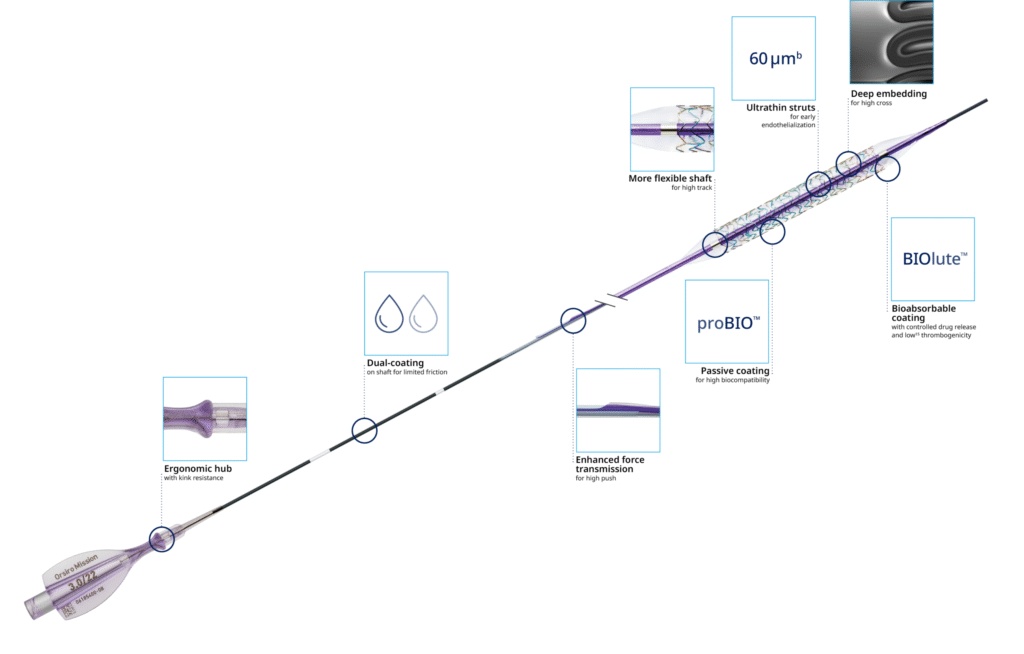
The next level of deliverability²
1st in Push3, 1st in Track3, 1st in Cross3
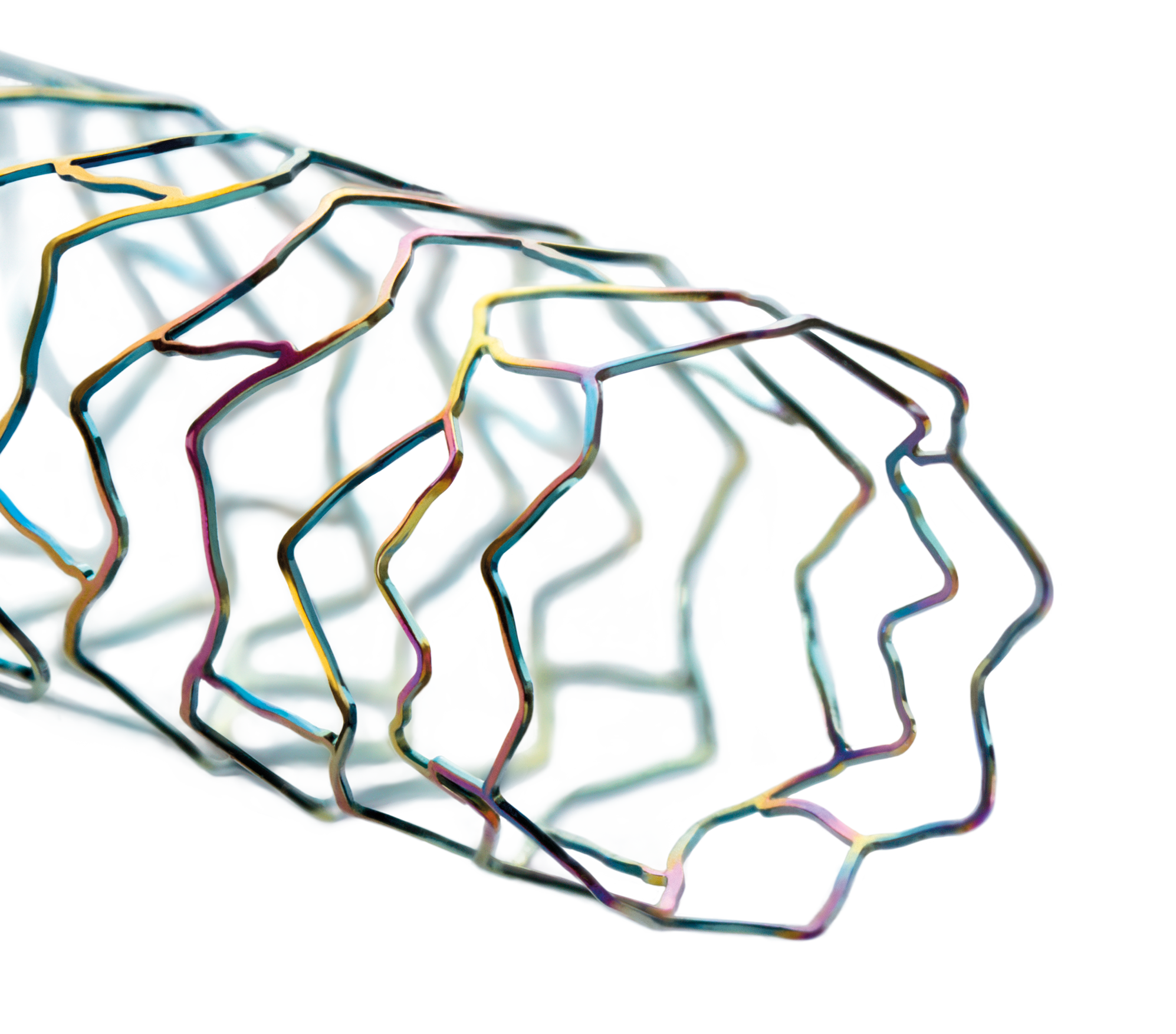
Ultrathin struts⁴
For early endothelialization5
Outstanding patient outcomes6,b
Proven superiority in STEMI up to 5 years1,b,c
Product Highlights
The next level of deliverability²
Orsiro™
Mission™
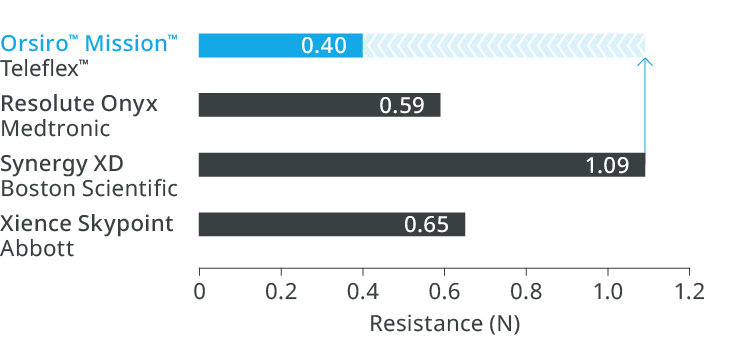
DES transmits up to 96% more force from hub to tipd, requires 33% less force to follow the path to the lesiond, and 64% less force to cross.e
1st in Push³
Transmitting up to 96% more force from hub to tip.
1st in Track3
Up to 33% less force needed to follow the path to the lesion.
1st in Cross3
Up to 64% less force needed to successfully cross demanding anatomies.
Ultrathin struts4
For early endothelialization5
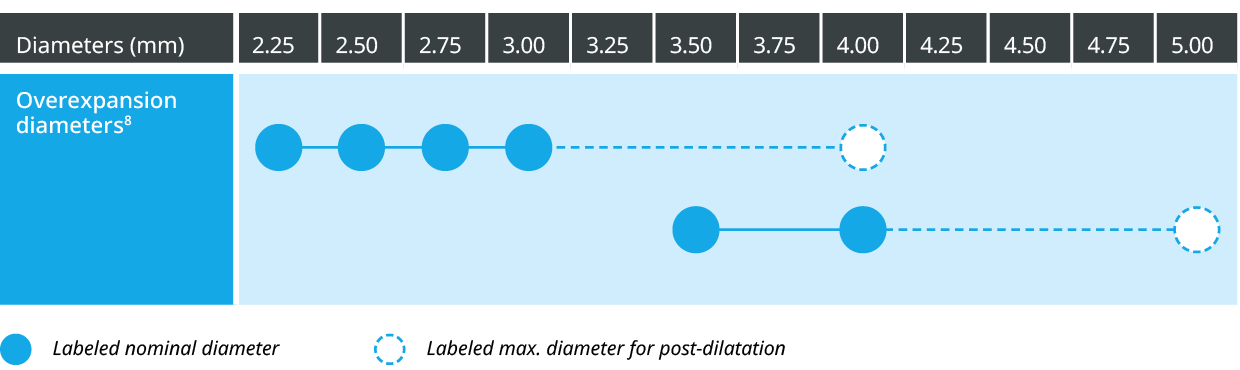
Conforming to a wider range of vessels7,f
Strut thickness in perspective8
Early endothelialization5
Outstanding patient outcomes6,b
Orsiro™
DES proves continued superiority in the first randomized controlled trial demonstrating superiority between two contemporary DES.12
Orsiro™ family of DES – One of the most studied DES14,b,i
Continued superiority in STEMI at 5 years15,b
Product Overview
Clinical Studies Overview
BIOSTEMI
Proven superiority with Orsiro™
DES in STEMI patients up to 5 yearsi,l
a. Data on file (n = 5), based on statistically significant differences on the bench for Pushability, Trackability, and Crossability compared to Xience Skypoint, superior to Xience in STEMI patients; b. Clinical data collected with OrsiroDES device within the OrsiroDES family clinical program; c. In comparison to Xience, based on TLF with OrsiroDES; d. In comparison to Resolute Onyx, Data on file; e. In comparison to Synergy XD, data on file; f. Always refer to the Instructions for Use (IFU) for the Maximum Diameter for post-dilation applying in your country; g. Ø 2.25-3.0 mm strut thickness 60 µm, Ø 3.5-4.0 mm strut thickness 80 µm; h. Images: Secco G et al. Time-related changes in neointimal tissue coverage following a new generation SES implantation: an OCT observational study. Presented at: euro PCR, May 20, 2014; Paris, France, i. Clinical data collected with OrsiroMission DES device within the OrsiroDES family clinical program, j. At 5-year in STEMI patients, k. Please refer to the IFU for indications and post-procedure antiplatelet therapy recommendations; l. Target Lesion Failure at 5-year follow-up OrsiroDES: 7.7%, Xience DES: 11.1%, BIOSTEMI with historical information RR, 0.70; 95% BCI, 0.51-0.95, Bayesian posterior probability, 0.988, difference: -31%.
1. Iglesias JF. et al, Long-term outcomes with biodegradable polymer sirolimus eluting stents versus durable polymer everolimus-eluting stents in ST-segment elevation myocardial infarction: 5-year follow-up of the BIOSTEMI randomized superiority trial, The Lancet, 2024; 2. In comparison to Xience Sierra, Resolute Onyx and Synergy for bench tests on pushability, trackability and crossability, data on file; 3. In comparison to Resolute Onyx, Xience Sierra and Synergy, data on file; 4. As characterized with respect to strut thickness in Bangalore et al. Meta-analysis; 5. Per investigators’ interpretation in Secco et al. Imaging data serial observations. Secco GG et al. Time-related changes in neointimal tissue coverage of a novel Sirolimus eluting stent: Serial observations with optical coherence tomography. Cardiovascular Revascularization Medicine. 2016; 17(1): 38-43; 6. Based on investigator’s interpretation of BIOFLOW-V endpoint results; 7. Based on Kapoor A. et al., The road to the ideal stent: A review of stent design optimization methods, findings, and opportunities, Materials&Design, 2024; 8. Stefanini GG et al. Coronary stents: novel developments. Heart. 2014 Jul 1;100(13):1051-61; 9. Low AF. Stent platform for procedural success: Introducing the Continuous Sinusoidal & Core Wire Technologies. Presented at: AsiaPCR; 22-24 January, 2015; Singapore, Singapore; 10. Tolentino A. Evolving DES Strategy: Biodegradable Polymer vs. Bioabsorbable Scaffold. Presented at: Cardiovascular Nurse/Technologist Symposium; June 17, 2016; New York, USA; 11. Secco G et al. Time-related changes in neointimal tissue coverage of a novel Sirolimus eluting stent: Serial observations with optical coherence tomography. Cardiovascular Revascularization Medicine 17.1 (2016): 38-43; 12. Iglesias J et al. Biodegradable polymer sirolimus-eluting stents versus durable polymer everolimus-eluting stents in patients with ST-segment elevation myocardial infarction (BIOSTEMI): a single-blind, prospective, randomised superiority trial. The Lancet. 2019 Sep 2.; 13. Data on file, status February 2023; 14. In large RCTs, based on Taglieri et al. Meta-analysis, against currently used DES; 15. Based on TLF primary endpoint. Iglesias, JF. et al. Long-term outcomes with biodegradable polymer sirolimus-eluting stent versus durable polymer everolimus-eluting stents in ST-segment elevation myocardial infarction: 5-year follow-up of the BIOSTEMI randomized superiority trial, presented at TCT 2023; 16. Kandzari D et al. Ultrathin Bioresorbable Polymer Sirolimus-Eluting Stents versus Thin Durable Polymer Everolimus-Eluting Stents for Coronary Revascularization: Final 5-year Outcomes from the Randomized BIOFLOW V Trial, Submitted manuscript to JACC, 2022: NCT02389946; 17. Valgimigli M et al. Circulation 2023 Aug 25; 18. Taglieri N et al. Target lesion failure with current drug-eluting stents evidence from a comprehensive network meta-analysis. JACC 2020.